
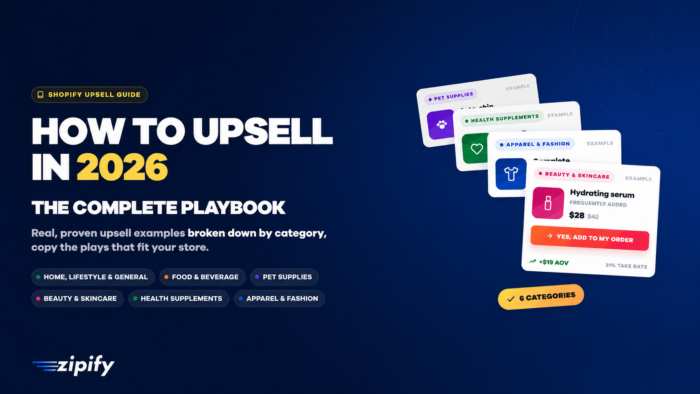
Most Shopify brands have one upsell placed after checkout. The best ones are capturing revenue at six different moments before, during, and after the sale.
Zipify’s network of 15,000+ Shopify stores has generated over $1 billion in upsell revenue. The patterns across those stores are consistent. The best upsell strategies aren’t complicated, they’re specific. The right offer, at the right moment, for the right customer.
This post covers what upselling is, where to place offers across the full funnel, and, the section no other guide has built, a category-by-category playbook that tells you exactly what to upsell based on what you sell.
All benchmarks and take rate data are drawn from Zipify’s internal dataset of 15,000+ Shopify stores running OneClickUpsell and our Zipify Plus merchant network.
What Is Upselling?
Upselling is offering a customer a more valuable version of what they’re buying, or a closely related add-on that makes their purchase better. It can happen at any point in the buying journey, on the product page before they add to cart, in the slide cart while they’re reviewing their order, during checkout, or after the transaction completes. The customer is in buying mode from the moment they land on a product page. A well-placed upsell meets them where that intent already exists.
- Good upsell: “You’re looking at a single bottle. Here’s the 3-pack at 20% off.” (product page or pre-purchase)
- Good upsell: “You’ve got the cleanser in your cart. Here’s the serum that completes the routine.” (Slide Cart)
- Good upsell: “You just checked out. Here’s the matching accessory, one click to add it.” (post-purchase)
- Bad upsell: Anything that feels random, unrelated, or timed to interrupt rather than extend.
The rule that governs every upsell in this guide: a good upsell makes the original purchase better.
Upsell vs. Cross-Sell: What’s the Difference?

Most effective upsell strategies combine both. OCU supports both offer types across every funnel placement.
The Highest-ROI Move You Still Control in 2026
The average Shopify store earns $1.21 per visitor. Top performers earn $2.00 or more. That gap is almost entirely explained by upsell strategy, same traffic, radically different revenue.
Zero added acquisition cost. You already paid to get the customer. Every accepted upsell is pure margin.
Ad costs are up. Margins are compressed. The upsell is the one number that sits entirely on your side of the table.
“I believe in upsells, and I don’t think brands are utilizing them well enough.” — Ezra Firestone
OCU merchants average a 16.2% conversion rate on their upsell offers. Underoptimized stores sit at around 4%. Most of that gap isn’t the tool, it’s merchants running a single post-purchase offer and calling it a upsell strategy. Brands leaving the product page, cart, pre-purchase, and Thank You Page empty are forfeiting 20–30% of potential revenue that was sitting right there in the funnel.
Where Every Dollar of Upsell Revenue Comes From: The Full-Funnel Map
Most merchants think upselling happens after checkout. The best merchants know it happens at six distinct moments in the customer journey, and most of those moments are currently left empty.
Product Page

One of the earliest touchpoints. An on-page widget showing complementary or upgraded products before the customer even adds to cart. Best for upgrade offers, bundles, and “frequently bought together” pairings. OCU’s Product Page Offer Widget supports up to 8 SKUs with split testing.
Slide Cart Drawer

The cart is open. The customer is reviewing their order. One relevant add-on shown here, combined with a free shipping reward bar that shows exactly how close they are to unlocking free shipping, turns a passive cart into an active revenue driver. Merchants enabling the Slide Cart Drawer see up to 20% AOV increases. Gussy’s Gut added +16.47% AOV in their first 30 days from this placement alone.
Pre-Purchase Popup

A targeted offer shown between “Add to Cart” and “Checkout.” Pre-purchase order bumps convert at 37.8%, the highest of any upsell type (Focus Digital, 2025). Savvy Touch drove 76% of their total upsell revenue from the Cart Drawer and pre-purchase stage combined.
In-Checkout (Shopify Plus Only)

For Shopify Plus merchants, in-checkout offers capture high-intent buyers at the final step before payment, supports up to 8 SKUs with split testing, and because the customer hasn’t completed the transaction yet, a relevant offer feels natural rather than intrusive.
Post-Purchase (One-Click)

The classic placement, and still the biggest volume driver. 62.1% of total upsell revenue flows through post-purchase. The customer has already purchased; accepting another offer takes one click with no payment re-entry. OCU merchants average a 16.2% take rate on post-purchase offers.
“We offered 2 travel-size sprays + wipes post-purchase — 70% take rate. $10 offer, pure margin.” — Ezra Firestone
Thank You Page

100% view rate. Zero optimization for most stores. A Thank You Page offer is seen by every customer who completes a purchase, making it one of the highest-efficiency placements relative to setup effort. 4% of upsell revenue flows through here. For most stores, that’s incremental margin that takes under 5 minutes to activate.
OneClickUpsell is the only Shopify upsell app with native placement across all six touchpoints in one system, no stitching together multiple apps, no fragmented analytics.
Try OneClickUpsell free for 30 days, every placement in this guide, one system.
TRY FREE FOR 30 DAYS | 100% MONEY-BACK GUARANTEE
The Category Playbook: What to Upsell Based on What You Sell
No competitor post has built this section. Most “how to upsell” guides cover generic tactics that could apply to any store. This one doesn’t.
Each category below follows the same schema: what to offer, where to place it, why it works, and which real brands have done it. If you sell in one of these verticals, this section was written specifically for you.
Beauty & Skincare
What to offer: Routine completion products (cleanser → serum → moisturizer), travel-size bundles of items already in cart, complementary tools (applicators, jade rollers), or a premium upgrade of the purchased item.
Best placement: Post-purchase for routine builders. Slide Cart for accessories. Pre-purchase popup for upgrade offers.
Why it works: Beauty buyers are invested in a result, not just a product. The upsell frames itself as “finishing the routine,” the next logical step to get the outcome they’re already shopping for. It’s not an add-on. It’s the completion.
What the data shows:
- Touch Skincare generated $6.6K in automated upsell revenue by pairing their KP Lotion with an exfoliating wash post-purchase. Set once, ran on autopilot.
- Yensa (Korean beauty) started from zero upsells. Their OCU Plus manager built funnels around their #1 best seller, foundation, offering a second unit post-purchase at 20% off. It converted at 15%+ immediately. Added $3K in the first week and stabilized at $5K/month. Their pre-purchase primer offer hit 14.9% conversion, at the high end of OCU benchmarks, before testing began.
- Eavara Skincare ran OCU across all 6 products in their catalog, using both pre- and post-purchase placements with continuous split testing. OCU accounted for 20% of all total sales by end of year. Key finding from their testing: percentage discounts (10% off) nearly doubled conversion rate over equivalent dollar-off offers ($3 off), even when the dollar amount was higher ($5 off still lost to 10%).
- Apple Rose Beauty used Zipify Pages landing pages to hit an 8% store conversion rate, 2.6x the industry average of 3%, by driving ad traffic to optimized product pages rather than default Shopify pages. Higher baseline conversion means every upsell downstream converts more too.
Ezra runs this same logic across BOOM Beauty, avatar-aligned post-purchase offers mapped to each product line. Boomstick Color buyers see a complementary eye product. Boom Clean buyers see a scrub pairing. Boom Silk buyers see a facial oil to seal in moisture. Same funnel architecture, different offer per product line, because different buyers have different next steps.
Health & Supplements
What to offer: Subscription/autoship upgrade on first purchase, bundle upgrade (30-day → 90-day supply), complementary products (protein + creatine, probiotic + prebiotic), same-product quantity increase at a discount.
Best placement: Post-purchase for quantity upgrades and subscriptions. Pre-purchase popup for bundle upgrades before checkout. Thank You Page for secondary products.
Why it works: Supplements are consumable, customers will reorder. Every first-time buyer is a potential subscriber. The upsell converts a one-time sale into an LTV asset. The window immediately after purchase, when commitment is highest, is where that conversion happens most efficiently.
What the data shows:
- Foria (health and wellness) joined OCU on the basic plan, then upgraded to OCU Plus with a dedicated account manager. Before the upgrade: only post-purchase offers on best sellers, zero pre-purchase. After: added bundle upgrades and single-product add-ons pre-purchase, pre-purchase revenue went from $0 to $21,370 in the first month and held at $10K–$20K/month for the following 12 months. Adding a “buy one, get one” same-product post-purchase offer drove a 16% lift in post-purchase conversion and pushed their most-viewed funnel to $6.81 revenue per visitor. Total: 90x ROI, nearly $1M in upsell revenue.
Returning customers convert 20–35% higher on upsells than first-time buyers (research via BIA/Kelsey). For supplement brands with a repurchase cycle, that’s a separate funnel worth building, a loyalty or bulk offer that converts your 2nd and 3rd-time buyers at a rate your new-buyer funnel never will.
Food & Beverage
What to offer: Bundle packs or variety sampler, complementary flavor or SKU, subscribe-and-save on a reorder, add-on accessories (grinder for a coffee brand, sauce for a hot sauce brand).
Best placement: Post-purchase for bundles and variety packs. Slide Cart for accessories. Pre-purchase popup for upgrade to a larger format.
Why it works: Food buyers are curious. A sampler pack lets them try more with less risk. The key insight from real store data: a multi-item offer at the right price point converts better than a discount on a single item because it increases perceived value, not just perceived savings. The customer feels like they’re getting more, not just paying less.
What the data shows:
- Java Planet Coffee was manually building upsell funnels and getting mediocre results. After switching to OCU’s AI-powered offers, which automatically match products by roast profile, flavor notes, and purchase history, their upsell revenue doubled. The AI removed the guesswork of “which coffee pairs with which?” and let the data decide.
- Fresh Chile Co. grew revenue 205% in 90 days after joining Zipify Plus and implementing a full-funnel upsell strategy across pre- and post-purchase placements.
- Cheech & Chong switched from single-item post-purchase offers to multi-product upsells and saw RPV nearly double, from $2.52 to $4.56, even as their take rate dropped. They also tested discount depth: 15% outperformed 20% by 7.4% CVR while protecting margin. Total: $90K in 7 weeks, 39x ROI after switching from Rebuy to Zipify Plus.
Apparel & Fashion
What to offer: Complete-the-outfit cross-sell (top → bottom, shoe → bag), premium version of the purchased item (standard → limited edition), care products (shoe cleaning kit, fabric spray), size upgrade (single → 2-pack of basics).
Best placement: Pre-purchase popup or Slide Cart for “complete the look” add-ons. Post-purchase for care products and accessories.
Why it works: Fashion buyers are aesthetically motivated. “Complete the look” works because it maps directly to the original intent, they’re not buying a shirt, they’re building an outfit. The upsell extends the vision they already walked in with.
Key tactic: Offers priced at 10–25% of cart value hit a 41.3% acceptance rate on pre-purchase popups (Focus Digital, 2025). For an apparel brand with a $60 AOV, that’s a $6–$15 add-on sitting in the highest-converting price window.
What the data shows:
- D’IYANU (culturally inspired fashion, Shopify Plus) used OCU Plus collection-based funnels and AI-powered offers to generate $43,961 in upsell revenue in 90 days, a +133% lift in monthly upsell revenue over what they were averaging before. The unlock was collection funnels: instead of building one funnel per SKU, a single funnel covered every product in a category (Women’s Dresses, Men’s Tops, Blazers), with AI matching the specific offer to each buyer. (Full D’IYANU case study)
- Hard Hat Watches (rugged smartwatches for tradespeople) built a three-step post-purchase funnel — silicone band → screen protector → branded water bottle — that converted at 30% on over 10,000 views and generated $311K in upsell revenue in its first 10 months. They then duplicated the same funnel for the UK market without any changes and pulled in an additional £5,500. Five months later, upsell revenue had doubled to $620K. (Part 1) | (Part 2)
Pet Products
What to offer: Same-product multi-pack or subscribe-and-save, complementary product (food → treats → supplements), upgrade to premium formula, breed-specific or size-specific add-on.
Best placement: Slide Cart for multi-pack upgrades. Post-purchase for complementary categories. Pre-purchase popup for subscribe-and-save upgrade.
Why it works: Pet owners are emotionally invested and repeat buyers by nature. The barrier to stocking up on something your pet loves is low. Multi-pack and subscription offers work here in a way they don’t in categories where repeat purchase behavior isn’t baked in.
What the data shows:
- Gussy’s Gut (pet wellness) activated the OCU Slide Cart Drawer from day one and added hyper-relevant add-ons directly in the cart, no checkout interruption. Result: +16.47% AOV in the first 30 days, with 50% of all upsell orders flowing through the Slide Cart alone.
- Savvy Touch (natural personal care) had been running only post-purchase upsells before enabling the Slide Cart Drawer. After adding pre-checkout cart upsells showing complementary products, the Slide Cart generated $38,134 in added revenue, accounting for 76% of their total upsell revenue. One placement change, not a funnel rebuild.
(Full Slide Cart case study — all three brands)
Home, Lifestyle & General
What to offer: Complementary accessory (product → tool to use it), care or maintenance kit, quantity upgrade, mystery bundle with guaranteed value.
Best placement: Post-purchase for accessories and care kits. Slide Cart for quantity upgrades. Thank You Page for mystery bundles.
Mystery upsell tactic: A mystery bundle at a guaranteed value threshold, “add $X in mystery products for $Y,” creates curiosity and perceived value simultaneously. Works especially well for brands with excess inventory or new SKUs that need exposure. The customer doesn’t know exactly what they’re getting, but they know the value floor.
What the data shows:
- Zipify Plus tested mystery upsell offers across three brands, Calm Strips, Manta Sleep, and CurlMix, and generated a combined $36K in additional revenue without deep discounting. CurlMix alone sold $8K in mystery products at a 22% conversion rate, driving a 138% increase in total upsell revenue. (Full mystery upsell case study)
Ezra’s 5 Upsell Rules (From a 9-Figure Shopify Operator)
These aren’t best practices assembled from a slide deck. They’re rules Ezra has validated on his own brands, BOOM Beauty, Navage, and others at 8–9 figures.
- Match the offer to the customer, not just the product. At every touchpoint in the funnel, the offer should reflect what that specific buyer wants next, not what you want to move. BOOM Beauty maps distinct offers to each product line buyer across pre- and post-purchase. Same infrastructure, different offer per avatar.
- One strong offer beats three mediocre ones. Whether you’re showing an offer in the cart, pre-purchase, or post-purchase, the moment you stack offers without logic, trust breaks and take rate drops. Simplicity at each touchpoint is strategy.
- Price on value, not discount depth. A 15% discount often outperforms 20%. In Cheech & Chong’s testing, 15% beat 20% by 7.4% CVR while protecting margin. Over-discounting is the most common upsell mistake across every category we’ve seen.
- The Thank You Page is 100% viewed and 0% optimized. Every brand has one. Almost no one uses it. A single offer block on the Thank You Page is one of the fastest AOV wins available, lowest setup time, highest baseline view rate, zero impact on the primary conversion.
- Your upsell isn’t done when it’s live, it’s done when you’ve tested it. The gap between 4% and 16.2% isn’t placement. It’s iteration. The stores with the best upsell performance run the most tests. Check out why upsells underperform for the nine most common fixable mistakes.
Stop Optimizing for Take Rate. Start Optimizing for Revenue Per Visitor.
Most merchants track the wrong number.

The Cheech & Chong lesson applies directly here. Their take rate went down when they switched to multi-item upsells. RPV nearly doubled, from $2.52 to $4.56. If they’d been tracking CVR alone, they would have called it a failure and reverted. The metric you optimize for determines the decisions you make.
How to Build Your First Upsell on Shopify
The platform doesn’t matter as much as the logic. Here’s how to think through your first offer before you build it:
- Pick your best-selling product. Don’t start with everything. Start with the one SKU that drives the most orders.
- Identify the logical next step. Use the category guide above. What would make that purchase more complete?
- Choose your starting placement. Post-purchase is the most common starting point because it doesn’t touch the primary checkout flow, but pre-purchase and Slide Cart upsells convert at even higher rates once you’re ready to test them. Pick one, build a single offer, 10–15% discount to start.
- Run a test checkout. Confirm the offer fires correctly before it’s live for real customers.
- Let it run for 2 weeks. Give it enough order volume to read the data clearly.
- Check take rate and RPV. Then test a different placement, a different product, or a different discount depth.
The first upsell is never the best one. It’s the starting point.
Once you’re ready to move faster: OneClickUpsell has every placement in this guide, Slide Cart, pre-purchase, in-checkout (Plus), post-purchase, Thank You Page, ready to configure in under 10 minutes, with no code required. Free for the first 30 days. That’s a full month of live testing before you spend a dollar.
FAQs About How to Upsell on Shopify
What is the difference between an upsell and a cross-sell?
An upsell offers a better, larger, or upgraded version of the product a customer is already buying. A cross-sell offers a separate, complementary product. Both increase AOV, upsells raise the value of the original decision, cross-sells extend the purchase. OCU supports both offer types across all six funnel placements.
What is a good upsell conversion rate on Shopify?
It depends on the placement. Pre-purchase order bumps convert at 37.8%, the highest of any type. Post-purchase one-click offers average 16.2% across OCU merchants. Underoptimized stores running a single post-purchase offer typically sit around 4%. The bigger question isn’t one number, it’s whether you have offers running at multiple points in the funnel, because each placement compounds the others.
What should I upsell if I sell supplements?
For supplement brands, the highest-performing upsells are quantity upgrades (single → 3-pack or 90-day supply) and subscribe-and-save conversions offered immediately post-purchase. Returning supplement customers convert 20–35% higher on upsells than first-time buyers, segment your returning customers into a separate funnel with a loyalty or bulk offer and watch the difference.
What should I upsell if I sell beauty products?
Beauty buyers respond best to routine completion offers, the next logical product in their skincare or makeup routine. Post-purchase is the strongest placement: offer the complementary step at 10–15% off immediately after checkout. Segment by product line if you sell to multiple buyer types, and start with one offer per product line before expanding.
How long does it take to set up a Shopify upsell?
With OneClickUpsell, your first upsell offer can be live in under 10 minutes, at any placement in the funnel. Install the app, enable the app embed, select a trigger product, choose your offer, set a discount, and run a test checkout. No code required.
Can upsells hurt my conversion rate?
Yes, if they’re irrelevant, poorly timed, or shown mid-checkout. The rule: never interrupt the primary purchase. Post-purchase and Thank You Page offers are completely safe because the transaction is already complete. Pre-purchase popups should be tested carefully, relevant offers typically don’t hurt CVR, but irrelevant ones create friction. Baymard Institute research consistently shows that unexpected interruptions are among the top drivers of checkout abandonment.
Your Upsell Launch Checklist
Before you close this tab, run through these eight:
☐ Map your top 3 SKUs to 2–3 complementary or “next step” products (or enable AI offers to do it automatically)
☐ Enable at least two placements, post-purchase alone leaves ~33% of upsell revenue on the table
☐ Set first offer discount at 10–15%, not 25–30%
☐ Run a test checkout before going live for real customers
☐ Configure the Slide Cart reward bar with a free shipping threshold set just above your current AOV
☐ Track RPV as your primary metric, not just take rate
☐ Schedule a 30-day funnel review, check take rate, RPV, and margin impact before making changes
☐ Create a separate funnel for returning customers with a loyalty or bulk offer
The Funnel You Build Today Is the Revenue Gap You Close Tomorrow
Rising CAC, compressed margins, more competition for the same clicks, none of that changes with a better upsell funnel. But your revenue per order does.
The brands adding $20K–$200K/year in upsell revenue aren’t running more complicated funnels than you. They’re running more specific ones, offer matched to buyer, placement matched to moment, tested until the number moves. That’s the whole game. Category-specific. Buyer-aware. Iterated over time.
You now have the map. The benchmarks are in the post. The category playbook is yours to use.
The 10 best Shopify upsell apps for 2026 compares the full field if you’re evaluating tools. For 3 high-impact offers worth testing first, start there. Or build your first funnel today with a free trial.
TRY FREE FOR 30 DAYS | 100% MONEY-BACK GUARANTEE
Doing $500K+ in revenue? Zipify Plus merchants average 26% AOV lift, 30x ROI, and $233K in additional upsell revenue per year — with Zipify’s team building and testing every funnel on your behalf. Book a free strategy call.
External sources: Focus Digital Average Upsell Conversion Rate Report, 2025 | Baymard Institute Cart Abandonment Research | BIA/Kelsey: Repeat Customers Spend More