
Black Friday 2026 lands on November 27, which leaves about four weeks to plan offers, build pages, write every email and SMS, and set up upsells. Adobe expects US shoppers to spend $275.1 billion online between November 1 and December 31, 2026, with $47.5 billion of it during Cyber Week (Adobe holiday forecast, September 28, 2026).
AI won’t run BFCM for you, but good BFCM prompts cut hours of drafting. I rebuilt this list for 2026: 30 prompts for ChatGPT, Claude or Gemini, sorted by the week you’ll need them, from margin math to the January retrospective. Each one has {placeholders} for your own store data.
Key Takeaways
- Black Friday 2026 is November 27 and Cyber Monday is November 30. Lock offers first, then pages, then messages.
- A BFCM prompt only works as well as the data you paste in: last year’s numbers, margins, top SKUs.
- Freeze your store design the week before Black Friday and spend the weekend on monitoring prompts, not rebuilds.
When Should You Start Each Part Of Your BFCM 2026 Plan?
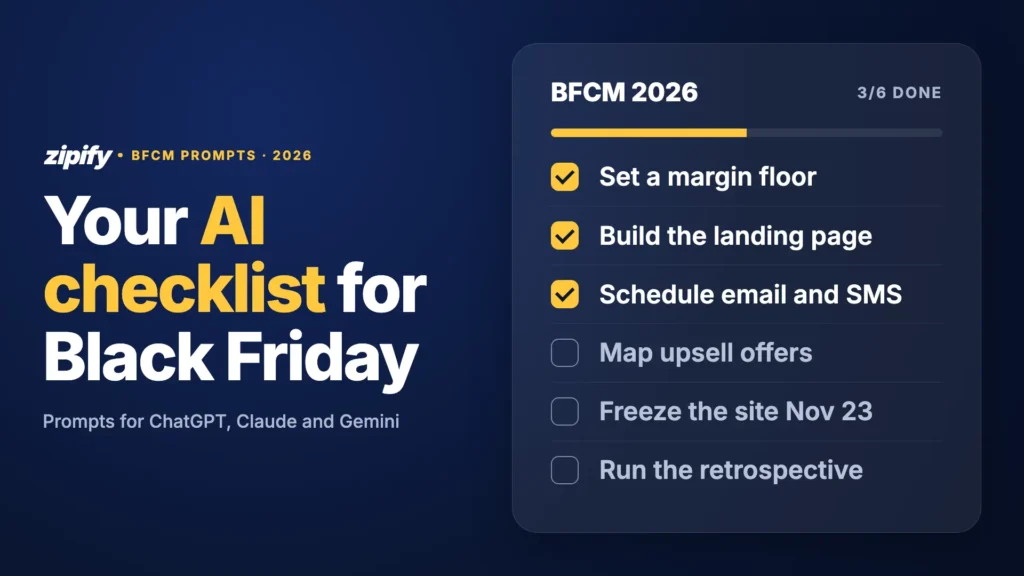
Start with offers and margins now, build pages and upsells in early November, schedule messages by mid-November, and freeze the site from November 23. The table below is a compact Shopify BFCM checklist that maps each week to the prompts in this article.
Scroll sideways for more →
| Week (2026) | What to finish | Prompts |
|---|---|---|
| Oct 26 – Nov 6 | Last year’s data, margins, offers, bundles | 1–5 |
| Nov 2 – Nov 13 | Landing page, site audit, cart and upsell offers | 6–10, 20–23 |
| Nov 9 – Nov 20 | Email, SMS and ad copy, ad tests | 11–19 |
| Nov 23 – Nov 25 | Code freeze, QA, early-access sends | 9, 14 |
| Nov 26 – Nov 30 | Thanksgiving to Cyber Monday monitoring | 24–27 |
| Dec 1 – Jan 15 | Report, retrospective, repeat-buyer plan | 28–30 |
The freeze matters because Adobe forecasts a record 63% of Thanksgiving online spend will come through phones, so a layout change pushed on November 26 gets tested by your customers instead of by you.
How Do You Customize An AI Prompt For BFCM?
Give every prompt four things: a role, a specific task, your own data, and the output format you want. Without your numbers, you get advice that fits any store.
What to paste in, from most to least useful:
- Last year’s BFCM export — orders, revenue, AOV (average order value, what each order is worth on average) and top products by day.
- Margins — cost of goods, shipping and payment fees per hero product.
- Offer history — which discounts, bundles and gifts you ran, and what they did.
- Brand rules — tone, words you never use, legal lines for promotions.
Then check every number the AI returns, never paste customer names or emails (totals and segments only), and keep the final call on prices with a human.
Analytics-focused prompt packs work the same way. Triple Whale’s 2026 list of 50 BFCM prompts is built around data inside its own analytics tools; the prompts below cover the build and copy work around the sale. Paste a past email or ad when you want the output in your voice.
Which AI Prompts Help You Plan Data-Backed BFCM Offers?
Offer prompts should start from last year’s results and a margin floor, not from a discount percentage. A Zipify customer test shows why: in Cheech & Chong’s discount test, 15% off converted at 17.95% against 16.71% for 20% off, with higher revenue per visit and better margin.
1. Last year’s BFCM post-mortem
You’re an ecommerce analyst. Here is our BFCM 2025 data: {paste daily orders, revenue, AOV, top 10 products, discount codes used}. List the 5 biggest wins and 5 biggest leaks, each with the number that proves it, and 3 things to change for 2026.
2. Margin floor calculator
Act as a finance lead for a Shopify brand. For each product below, calculate the deepest discount we can offer and still keep a {20}% contribution margin after COGS, shipping and payment fees: {paste product, price, COGS, shipping, fees}. Return a table.
3. Bundle builder
You’re a merchandising strategist. From our catalog {paste top 20 products with price and margin}, suggest 3 BFCM bundles that raise AOV and keep at least a {20}% margin. Give each a name, the products, a price and the reason to buy.
4. Free-gift threshold
Our current AOV is {$X} and our cheapest giftable product costs us {$Y}. Recommend a free-gift threshold for BFCM and show the math: expected AOV lift needed to break even, and the margin at that threshold.
5. Offer calendar
Plan our BFCM 2026 offer calendar from November 19 to December 1 (Black Friday is November 27, Cyber Monday November 30). Our offers: {list}. Show which offer runs each day, who sees it first (VIPs, subscribers, everyone) and when each one ends.
Which Prompts Help You Build A BFCM Landing Page?
A BFCM landing page needs one offer, a clear deadline and a layout built for phones, since Adobe expects 57.4% of holiday online spend to come from mobile.
6. Landing page wireframe and copy
You’re a conversion copywriter. Build a mobile-first BFCM landing page for {offer} on {product}. Give the section order (headline, subhead, hero, 3 benefits, social proof, deadline, FAQ, CTA) and write the copy for each. Headline under 10 words.
7. Website UI audit for BFCM
Act as a UX reviewer. Here are our mobile homepage, product page and cart: {paste screenshots}. List 10 things that would slow a BFCM shopper down, ranked by effort and impact.
8. Collection page for gifts
Write a BFCM gift-guide collection page for {store}: a 50-word intro, 4 filters (price, recipient, category, bestseller) and a 15-word description per product: {list}.
9. Pre-freeze QA checklist
Create a QA checklist for our Shopify store to run on November 23, before our code freeze. Cover discount codes, landing pages, cart, checkout, upsells, email links, mobile speed and inventory sync. Table with owner and pass/fail columns.
10. App and speed cleanup
Here’s our Shopify app list: {paste}. Flag apps unused for 90 days, overlapping apps and scripts that may slow the storefront. Recommend what to remove before BFCM.
If you build pages in Zipify Pages, paste the copy from prompt 6 into one of its 125+ templates instead of designing from scratch.
Which Prompts Write Your BFCM Email And SMS Campaigns?
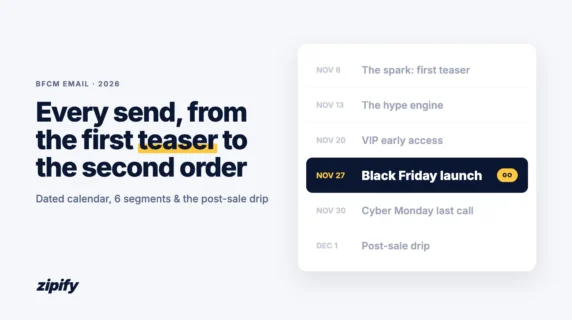
Email and SMS prompts work best when they’re split by segment: past BFCM buyers, VIPs, subscribers who never bought, and cart abandoners each need a different message. For the full send schedule, see the 3-week BFCM email strategy.
11. Segmented win-back emails
You’re a direct-response email strategist. Write 3 emails for customers who bought during BFCM 2025 but not since. Version A for VIPs ({definition}), version B for one-time buyers. Include subject line, preview text and body.
12. Early-access teaser
Write a teaser email and a 160-character SMS announcing VIP early access to our BFCM sale, opening November 24 at {time}. No discount amount in the teaser. Create curiosity about {offer}.
13. Launch-day email set
Write 3 Black Friday emails for November 27: 6 a.m. launch, 2 p.m. bestseller reminder, 8 p.m. “ends soon” if our offer ends that night. Offer: {offer}. Keep each under 120 words.
14. SMS schedule
Plan 6 SMS messages from November 24 to November 30, each under 160 characters, with send time, segment and a trackable link placeholder. Don’t send more than one per day per subscriber.
15. Cyber Monday last call
Write two final-hours messages for Cyber Monday, November 30: one email and one SMS, for subscribers who opened a BFCM email but didn’t buy. Offer: {offer}. Give a real reason to buy now, such as the offer ending or limited stock.
Which Prompts Help You Test And Write BFCM Ads?
Ad prompts should produce variants you can test before Black Friday, not on it. Adobe forecasts Black Friday spend will grow 9.2% to $12.9 billion, faster than Cyber Monday, so the ads that win in mid-November test runs deserve your Thursday budget.
16. Cross-channel ad variants
You’re a performance marketer. Our BFCM offer is {offer}. Write 3 Meta ad variants (UGC hook, benefit, problem/solution) and 3 Google search headlines under 30 characters.
17. Mini A/B test plan
Design a BFCM pre-test for paid social from November 10 to 20: 3 ad sets testing headline, creative and offer framing, {$X} per ad set. Give the success metric, minimum spend before a decision, and the rule for scaling the winner.
18. Creative brief for UGC
Write a 30-second BFCM UGC video brief for {product}: a 3-second hook, 3 talking points, the offer line and 2 alternative hooks.
19. Retargeting by behavior
Write retargeting copy for 3 audiences: product viewers, cart abandoners, past buyers. Offer: {offer}. Two variants each, under 125 characters.
Which Prompts Raise Order Value In The Cart And After Checkout?
Upsell prompts decide which offer to show at each step, from product page to thank-you page, and write it short. In the same Cheech & Chong test series, a 3-bag offer converted at 10.19% against 14.48% for 1 bag, yet revenue per visit rose from $2.52 to $4.56. That’s why every prompt here asks for revenue per visitor (RPV, revenue divided by visitors), not conversion rate.
20. Offer map for every placement
You’re a CRO strategist. Our top products are {list with price and margin}. For each, suggest one offer per placement: product page, cart, checkout, post-purchase and thank-you page. Say why each fits and how we’ll judge it by revenue per visitor.
21. Tiered cart rewards
Our AOV is {$X}. Design 3 cart reward tiers for BFCM (for example free shipping, gift, extra discount) with thresholds and the progress-bar message for each. Show the margin at each tier.
22. Pre-purchase bundle upgrade
Write a product-page upsell that offers to upgrade {product} to a bundle of {bundle} for {price}. Headline under 8 words, one benefit line, button text under 4 words.
23. Post-purchase offer copy
A customer just bought {product}. Write 2 post-purchase upsell offers under 40 words each: one complementary product, one “same item as a gift” offer for the holidays. Add a headline and a guilt-free decline link.
Tiered rewards are covered in more depth in this 3-tier cart strategy. To run the offers these prompts write, OneClickUpsell (OCU) covers product-page, cart, checkout and post-purchase placements in one app; its Slide Cart Drawer shows up to 8 AI-powered offers, and in-checkout upsells run on Shopify Plus. Triquetra Health earned 65% of its OCU revenue from pre-purchase “Upgrade to Bundle” offers, the same type prompt 22 writes.
Try OneClickUpsell free for 30 days
Product-page, cart, checkout and post-purchase offers in one app, from $9.95/month after the trial.
Which Prompts Help During The Black Friday Weekend?
Weekend prompts are for reading numbers and reacting fast, not for building anything new. Adobe expects Cyber Monday to stay the biggest day at $15.1 billion, so you have until November 30 to fix whatever Black Friday shows you.
24. Hourly check-in
Here’s today’s hourly data: {orders, revenue, AOV, conversion rate, traffic sources} and the same hours last year: {paste}. Name the 3 numbers that look wrong and the likely cause of each.
25. Low-stock alert
{Product} has under {20} units left. Write a back-in-stock waitlist message, a low-stock product-page banner, and a cart reminder email under 80 words for shoppers who viewed it.
26. Cyber Monday pivot
Black Friday came in {X}% below target. Our offers were {list} and our numbers are {paste}. Suggest 3 changes for Cyber Monday (offer, audience, channel) that don’t cut margin below {20}%, ranked by expected impact.
27. Support macros
Write 6 short BFCM support replies: code not working, shipping cutoff, gift receipt, out of stock, price drop after purchase, delivery delay.
Which Prompts Turn BFCM Results Into A Retrospective?
A retrospective prompt turns five days of sales data into next year’s plan while the details are fresh. Run it in early December, then again in January once returns are in.
28. Post-BFCM report
You’re a data analyst. Build a BFCM 2026 report from this data: {paste}. Cover revenue vs target, AOV, revenue per visitor, offers, email and SMS, ad cost per purchase and returns. End with 3 learnings and 2 actions.
29. Retrospective meeting template
Create a 45-minute BFCM retrospective agenda for {N} people: what worked, what broke, what to cut, what to test earlier. Add 5 questions per team and a decision log.
30. First-time buyer follow-up
Write a 4-email flow for customers whose first order was during BFCM 2026: thank-you, how to use the product, a review request, and a non-discount reason to come back in January.
For the follow-up strategy behind prompt 30, read how to turn one-time BFCM buyers into loyal customers.
The Bottom Line
The stores that get the most from AI during BFCM paste in real numbers, lock offers early and leave the last week for checking, not building. Start with prompts 1 and 2 this week, because every later prompt depends on knowing your margin floor.
If cart and post-purchase offers are on your list, OneClickUpsell runs on 50,000+ Shopify stores, starts at $9.95/month and comes with a 30-day free trial, so you can set offers up before November 27.
Frequently Asked Questions
When should I start planning BFCM 2026?
Start planning offers and margins at least four weeks before Black Friday, which falls on November 27, 2026. That leaves time to build landing pages and upsell offers in early November, schedule email and SMS by mid-November, and freeze site changes around November 23 so the store you tested is the store shoppers see on Thanksgiving.
What should a Shopify BFCM checklist include?
A Shopify BFCM checklist should cover offers and margin floors, a mobile landing page, discount-code tests, cart and checkout QA, upsell offers, email and SMS schedules, ad tests, inventory sync, support replies and a post-sale report. Give each item an owner and a deadline, and run a test purchase on a phone before your code freeze.
How do I customize BFCM prompts with my store’s data?
Replace every placeholder with your own numbers: last year’s BFCM orders, AOV, top products, margins and past offers. Add a role (“you’re an ecommerce analyst”), one clear task and the format you want back, such as a table. Paste totals and segments only, never customer names or emails, and check every number the AI returns.
Which AI tool works best for BFCM prompts?
ChatGPT, Claude and Gemini all handle these prompts well, so pick the one your team already uses and can share files in. The bigger difference comes from the input: a prompt with last year’s sales export and your margins beats a better model with no data. Analytics platforms with built-in assistants can answer data questions directly from your store numbers.