
Most BFCM email plans break in two places. The whole list gets the same discount blast, and the inbox goes quiet the day the sale ends. BFCM email marketing is the set of campaigns and automations a store sends from early November through December: they build demand before Black Friday Cyber Monday, convert it during the 4-day sale and turn first-time buyers into repeat customers afterwards.
This guide gives you a dated 2026 send calendar (Black Friday is November 27, Cyber Monday is November 30), the segments to build first, how to personalize past the first name, how deep to discount and what to send once the sale ends. I checked every number against the 2025 BFCM reports from Klaviyo and Mailchimp, plus Google’s own sender rules.
Key Takeaways
- Start teaser emails 3 weeks before Black Friday and hold back deep discounts. Anticipation does more of the selling than the size of the markdown.
- Build segments on clicks and orders, not opens, because privacy features inflate open data.
- Personalize the products and the offer each segment sees, not just the greeting.
- Keep sending through the weekend between Black Friday and Cyber Monday.
- Plan the post-sale drip around first-time buyers, and judge every campaign by revenue per recipient.
When Should You Start BFCM Emails, And What Should You Send Each Week?
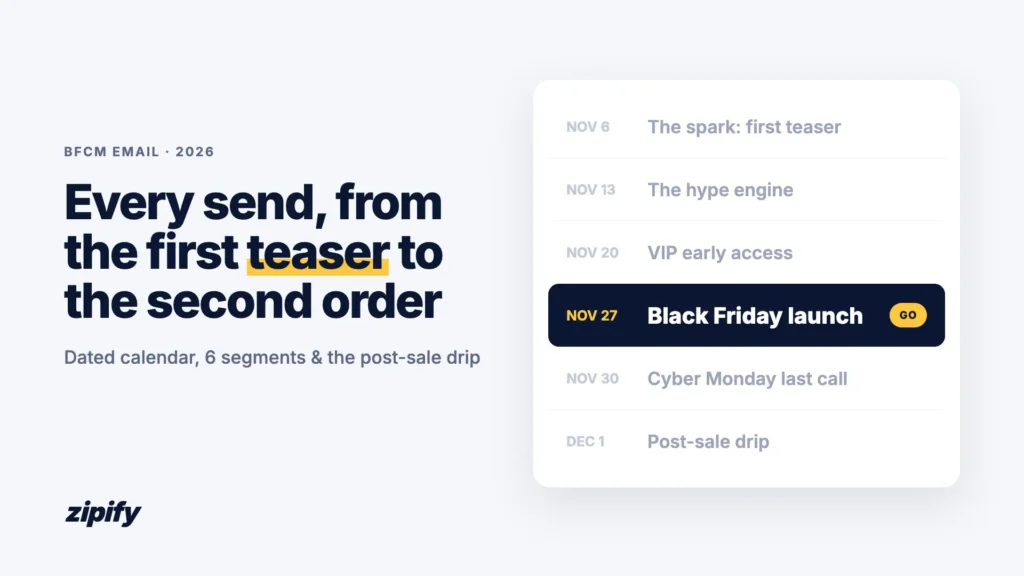
Start list prep now and send the first teaser on November 6, 2026, 3 weeks before Black Friday. The tease phase builds curiosity and an early-access list, so that on November 27 your most engaged subscribers are already waiting for the email.
Here’s the full 2026 calendar, phase by phase, with example email ideas you can adapt:
Scroll sideways for more →
| Dates (2026) | Phase | Goal | Example emails | Send to |
|---|---|---|---|---|
| Oct 26 – Nov 5 | Prep | Clean the list, confirm authentication, build segments, launch the early-access page | “What’s on your wishlist?” preference email | Subscribers who clicked or bought in the last 90 days |
| Nov 6 – 12 | Week 1: The Spark | Curiosity | “BFCM is coming, and we’ve planned it differently this year”; behind-the-scenes restocks and staff picks; a founder note on the brand’s mission | Engaged subscribers |
| Nov 13 – 19 | Week 2: The Hype Engine | Educate and build desire | Best-seller breakdowns (“Why customers reorder [product]”); reviews and UGC; the benefit behind the product, not the price | Engaged subscribers, split by category interest |
| Nov 20 – 26 | Week 3: The Final Countdown | Prepare to buy | VIP early-access invite; shipping and returns FAQ; bundle preview | VIPs and early-access sign-ups |
| Nov 27 (Black Friday) | Launch | Convert | Sale-open email; a second send to non-clickers later the same day | All engaged segments |
| Nov 28 – 29 (weekend) | Keep going | Convert the browsers | Category spotlights, gift guides, cart reminders | Non-buyers who clicked or browsed |
| Nov 30 (Cyber Monday) | Last call | Close | Final call with the real end time | Non-buyers only |
| Dec 1 – 31 | Post-sale drip | Second purchase | The 4-email drip below | New BFCM customers |
Don’t go quiet over the weekend. In Mailchimp’s 2025 peak-season data, weekend order rates were 2x weekday rates even though brands sent roughly 60% fewer messages on Saturday and Sunday. If you need 20 more campaign ideas for the tease weeks, Zipify’s no-discount playbook of email and SMS campaigns maps one to each week.
How Do I Segment My Email List For BFCM?
Segment your BFCM list by what subscribers have done (orders, clicks, product views) and send each group a different email. Six segments cover most of a Shopify store’s BFCM revenue, and each one gets a different message, offer and send frequency.
Scroll sideways for more →
| Segment | How to build it | What to send |
|---|---|---|
| VIPs | 3+ orders, or your top 10% by lifetime spend | Early access and first pick of bundles instead of a deeper discount |
| Recent first-time buyers | First order in the last 90 days | Complementary products and a reason to come back |
| Engaged non-buyers | Clicked an email in the last 90 days, never ordered | Best sellers, reviews and a clear first-purchase offer |
| Category interest | Viewed or clicked a category or product | That category’s offers only |
| Cart and checkout abandoners | Started checkout, no order (run as a flow, not a campaign) | Reminder with shipping and returns answers before any extra discount |
| Lapsed | No click or order in 90–180 days | Only the launch email and the last call; suppress anyone inactive for 180+ days |
Build “engaged” on clicks and orders. According to Litmus, Apple’s Mail Privacy Protection affects roughly 55–60% of all email opens (data current as of October 1, 2026), so an “opened in the last 90 days” segment includes thousands of people who never saw the email. A smaller list that actually clicks protects your sender reputation during the busiest sending week of the year.
How Do You Personalize BFCM Emails Beyond The First Name?
BFCM email personalization means changing the products, the offer and the message for each segment, not just merging a first name into the subject line. The same Mailchimp 2025 peak-season report found that emails using segmentation and personalization (dynamic content) saw 11% higher average order value than those that didn’t.
Use 4 levers, in this order:
- Products. Fill the product block from each subscriber’s last purchase or most-viewed category, and leave out items they already own.
- Offer. VIPs get access, first-timers get a simple entry offer like a free-shipping threshold, and repeat buyers get bundles.
- Message. Gift shoppers need delivery cut-offs, while existing customers respond to “what’s new” and “complete the set.”
- Timing. Send VIP emails before the public launch, and cart reminders within hours of the visit.
Here’s how one 20%-off offer can become three different emails for a hypothetical skincare store:
- VIP: “Your early access starts now (24 hours before everyone else)”, with a curated set of best sellers and a thank-you note.
- First-time shopper: “Find your routine: 20% off our most-reviewed products”, leading with reviews and a “which product is right for me” guide.
- Repeat buyer: “You bought the cleanser. Here’s the serum that goes with it”, featuring a complementary product chosen from their last order.
How Deep Should Your BFCM Discount Be?
Shallower than most stores think. Over BFCM 2025, Klaviyo reported that consumer spending rose 11% year over year even as discounts fell 10%, and brands offering the smallest discounts saw the highest growth, up 14% year over year.
Deep discounts cut margin on every order, including orders that would have happened anyway, and they train subscribers to wait for a bigger number next year. A content-led tease does the persuading instead: by launch day, the reader already knows which product they want and why.
Zipify’s own test data points the same way. In post-purchase upsell tests that Zipify’s OCU Plus team ran for Cheech & Chong with OneClickUpsell (OCU), a 15%-off offer converted at 17.95% vs 16.71% for 20% off: the smaller discount converted 7.4% better, earned more revenue per visit and kept more margin on each sale. Before you set your BFCM discount, test a smaller one against it on the same traffic.
How Do You Keep BFCM Emails Out Of Spam?
Meet Google’s bulk-sender rules before your volume goes up. Google’s email sender guidelines apply to anyone sending 5,000+ messages a day to Gmail accounts, a volume a mid-sized list can pass on launch day alone.
Check these 5 items before November 6:
- SPF and DKIM are set up for your sending domain.
- DMARC is published for the sending domain (a policy of “none” is enough to start).
- One-click unsubscribe is supported in marketing emails, plus a visible unsubscribe link in the body.
- Spam rate in Google Postmaster Tools stays below 0.10%, and never reaches 0.30% or higher.
- Volume ramps gradually. Send the first teasers to your most engaged segments, and widen the audience only while complaint rates stay low.
What Should You Send After BFCM?
Send a 4-email drip to every new BFCM customer, timed to land before the second purchase usually happens. In Mailchimp’s 2025 data, first-time buyers placed 59% of BFCM email orders, and of the shoppers who first bought during peak season, 16.6% bought again in Q1 2026, after a median of 26 days.
“The game is won or lost on the back end.” – Ezra Firestone, founder of Zipify
The first follow-up happens before any email: the page between checkout and the thank-you page. A post-purchase upsell offers a complementary item the shopper accepts with one click, without re-entering payment details. With OCU, that offer runs on every Shopify plan, and it can be dynamic: in Cheech & Chong’s tests, a “Same Item as Bought” offer almost doubled the conversion rate of a long-form content offer. Then the drip takes over:
- Thank you (immediately). Celebrate the customer and the brand’s mission. A short founder video or a customer spotlight sets the tone.
- The experience (3–5 days later). How-to guides, care instructions and customer favorites, which help cut returns and lift satisfaction.
- The social loop (7–10 days later). Ask for a review and show UGC. If you offer store credit, offer it for any honest review, positive or negative, and say so in the email.
- The smart upsell (14–21 days later). “You loved X. Complete the set with Y,” with a complementary product and no steep discount. Sending it before day 26 means it lands ahead of the typical repeat buyer’s next order.
For subject lines, A/B test ideas and metrics for each of these emails, see Zipify’s 4-email post-purchase drip for the holidays.
See everything for the season
Free tools, trainings and webinars in Zipify’s Black Friday 2026 toolkit, plus the Zipify app bundle for BFCM.
How Do You Measure Whether Your BFCM Emails Worked?
Measure revenue per recipient: email-attributed revenue divided by delivered emails. Revenue per recipient shows which campaign made money from the list it was sent to, which open rate (inflated by privacy features) and conversion rate (blind to order size) can’t.
For example, a hypothetical store’s Black Friday launch to 50,000 subscribers earns $9,000, or $0.18 per recipient. Its VIP early-access email to 4,000 subscribers earns $2,400, or $0.60 per recipient. The VIP email made less in total, but it earned more than 3x as much from each person it reached.
The same rule applies to the offers those emails send people to. In a Cheech & Chong quantity test with OCU, conversion fell from 14.48% for 1 bag to 10.19% for 3 bags, yet revenue per visit rose from $2.52 to $4.56. Optimize for revenue per visit and per recipient, not conversion rate. In January, add two checks: profit after discounts and returns, and how many BFCM first-timers have placed a second order.
What Tools Do You Need To Run This BFCM Email Plan?
You need three pieces: an email platform, a landing page for early access and an upsell app for the on-site moments email can’t reach.
- Email platform. Pick one that syncs Shopify order data for segments, runs flows (welcome, abandoned cart, post-purchase) and handles one-click unsubscribe headers.
- Early-access landing page. A gated “email-only early access” page grows the list and creates scarcity during the tease weeks. Zipify Pages has 125+ templates to build it from.
- Upsell app. OneClickUpsell adds offers on the product page, in the Slide Cart Drawer, on the post-purchase page and on the thank-you page, plus in-checkout offers on Shopify Plus. It starts at $9.95/month with a 30-day free trial, every feature is on one plan, and the price scales with the upsell revenue OCU earns you, never with order volume. Split testing is included, so you can test the BFCM discount depth before the sale.
Start your 30-day OCU free trial
Final Thoughts: Play The Long Game
The biggest BFCM wins don’t come from bigger discounts. They come from educating subscribers before the sale, segmenting and personalizing during it, and serving customers after it, so the first order turns into a second one.
You already have the list, and now you have the calendar. Clean it up by November 5, start the tease on November 6 and have the post-sale drip ready before Black Friday. That’s a BFCM email marketing strategy built for lifetime value, not just one weekend’s AOV.
Frequently Asked Questions
Is it too late to start BFCM email marketing in November?
No. A shortened plan still works if you start by mid-November. Spend the first days on authentication and a clicks-based engaged segment. Then send one teaser and one early-access invite the week before Black Friday, and run the launch, weekend and Cyber Monday sends as planned. What you lose by starting late is time to grow the early-access list, not the sale itself.
How many BFCM emails should I send?
Most stores can plan on 1–2 teaser emails a week for 3 weeks, then about 4–6 sends between Black Friday and Cyber Monday. Your most engaged segments can take more, and lapsed subscribers should get only the launch and the last call. Watch the complaint rate in Google Postmaster Tools after every send, and cut frequency for any segment that pushes it up.
Should I email unengaged subscribers during BFCM?
Only a little. Send subscribers with no clicks or orders in 90–180 days the launch email and the final call, and suppress anyone inactive for longer. Unengaged addresses add little revenue, and their spam complaints can push your spam rate toward Google’s 0.30% limit. That puts inbox placement at risk for the customers who would have bought.
Do I need a separate landing page for BFCM emails?
Yes, at least for early access. A dedicated page lets you collect sign-ups during the tease weeks, tag them as a segment and send them to one focused offer on launch day instead of a generic homepage. Keep it to one offer, a countdown to the real start time and a single sign-up form. Zipify Pages has 125+ templates you can start from.