

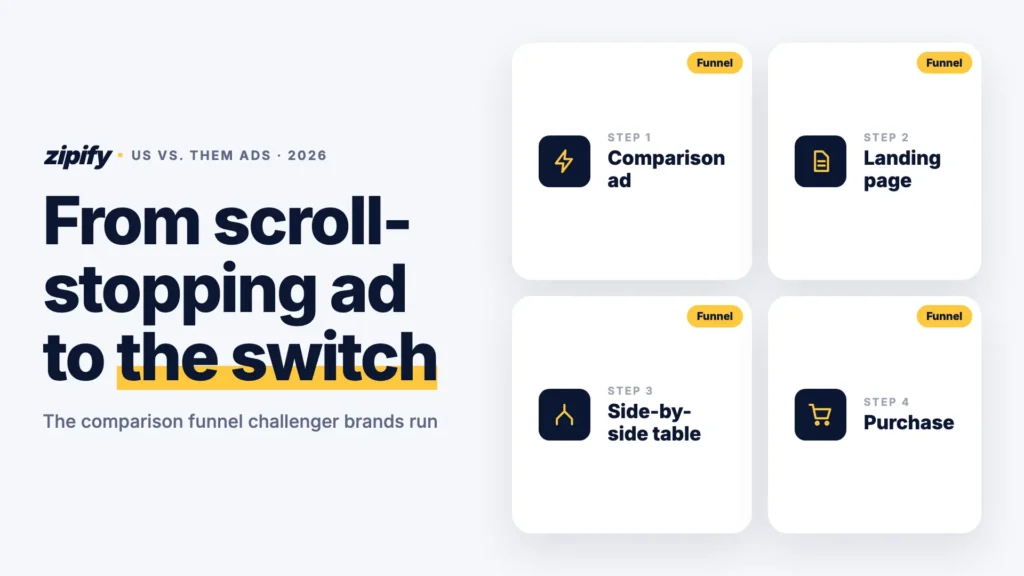
In a crowded marketplace, your job isn’t to say why you’re great. It’s to show why you’re better than everyone else, and make that difference unmistakable.
That’s exactly what “Us vs. Them” marketing does.
An “us vs. them” ad puts your product next to the option your buyer already uses (a named competitor, a generic version or the old way of doing things) and shows the difference side by side. It’s a form of comparative advertising, which the FTC has encouraged since 1979 as long as the comparison is clear and truthful.
It doesn’t just highlight your strengths—it delivers a side-by-side comparison that gives customers the clarity, confidence, and contrast they need to switch.
Naväge vs Neti Pot: how we stole market share
When we acquired the nasal care brand Naväge, we were stepping into a category dominated by Neti Pot. Just like Kleenex or Q-Tip, they had the name recognition, the customer base, the inertia. For us to survive, we needed to steal their market share.
So instead of pretending they didn’t exist, we called them out directly with marketing that said here’s why we’re better than them:

This changed everything. It reframed the conversation, and it helped us scale in a vertical no one else wanted to touch.
3 reasons why “us vs. them” works
1. It targets switch-ready buyers
Most customers aren’t new to the category. They’re already using some solution—they just haven’t been shown a better way yet. That’s your job.
2. It gives the ad platform a clearer signal
Meta now relies on the ad itself to work out who should see it. Its Andromeda ads retrieval engine picks which ads each person sees from a growing pool of creatives, and Meta says more ad diversity drives better advertiser outcomes. Zipify’s breakdown of how Andromeda changed Meta ads covers what that means for your creative. An “us vs. them” ad gives the system a lot to work with:
- It’s specific. It names the alternative your customer is likely already using, which gives shoppers a clear signal.
- It creates contrast. It visually and verbally highlights meaningful differences between your product and theirs.
- It shows who it’s for. People who already buy the alternative recognize the comparison at a glance, and the ones who stop on it tell the platform who to find more of.
3. It simplifies decision making
People aren’t looking for more options. They’re looking for a reason to choose. A direct comparison narrows the choice to two and hands shoppers that reason.
Key Takeaways
- Compare against the option your buyer already uses: a named rival, a generic version or the old way of doing it.
- Pick three to five differences you can prove, and show them side by side in the ad and on the page it links to.
- Send the click to a page that continues the comparison, not to a plain product page.
- Comparative claims need the same proof as any other ad claim, and the brand you name can challenge a false one.
- If you’re the market leader, naming a smaller rival mostly advertises them.
10 Real-World Examples of “Us vs. Them” Ads
We’ve run this play across multiple brands—and as you can see, everyone from startups to billion-dollar brands are doing it to punch above their weight and win.
Naväge vs. Neti Pot
This is a textbook “Us vs. Them” example that uses a very visual side-by-side comparison and copy to show why Naväge’s powered suction system offers better performance and is an innovation over the old-school Neti Pot:

Grüns vs. AG1
Grüns goes straight at the market leader with this ad that compares the macros side by side: more fiber, fewer calories, fewer net carbs. It uses the “Us vs. Them” to position itself as the cleaner, more efficient upgrade:

Millie Moon vs. Coterie
Here Millie Moon uses “Us vs. Them” via a sponsored influencer post to position their budget-friendly brand as having the same quality and features to their higher-priced competitor:

Panda Pillow vs. generic pillow
This ad nails the comparison format. On the left: Panda’s breathable, hypoallergenic, supportive bamboo pillow. On the right: your generic pillow. It’s clear, visual, and doesn’t even need to call out a specific competitor:

I Heart Nature vs. other brands
This ad keeps it clean and literal. It shows two similar-looking soaps, but contrasts them with clear messaging about ingredients, formulation, and value:

Monday.com vs. your current CRM
This ad also skips traditional comparison copy and lets the imagery do the talking with a visual metaphor that communicates what every CRM buyer wants—clarity, simplicity, and control:

AgelessLX vs. “fad” diets
This ad flips the script by comparing results, not brands. Before & after is a similar concept on “Us vs. Them” that positions the product as a smarter, science-backed solution—without naming a competitor.

Pacasocks, Justuno, and Vivanmn
And finally, here are 3 more examples to drive this home from Pacasocks, Justuno, and Vivanmn:

These 10 ads aren’t trying to be mean or aggressive. They’re clarifying. And they work because they show—not just tell—why the switch is worth it.
“Us vs. Them” Marketing Works Everywhere
This isn’t just a one-off play—it creates reusable assets you can deploy across your entire marketing mix.
- Cold traffic
- Retargeting sequences
- Autoresponders
- Email flows
- Blog posts
- Influencer campaigns
- Product launches
You can plug this into almost any existing funnel you want to boost performance and build confidence in your customers.
How to Create Your “Us vs. Them” Marketing Funnel
Okay, now that you know what “Us vs. Them” marketing is and why it works, let’s walk through how to actually do it. The two core pieces you’ll need are a comparison ad that stops the scroll and a landing page that keeps the story going.
Step 1: create your own “us vs. them” ad
Your ad should do one job: create a clear, compelling contrast that makes your product the obvious upgrade. Here are 3 things to make your “Us vs. Them” ad compelling:
Strong visual comparison
Use side-by-side layout, labeled clearly (“Us” vs. “Them” or “Before” vs. “After”), and feature visible product differences like the examples above.
Hook the pain or category
Call out a frustration with the competition—something your target audience would know if they used it. Grüns does a good job of this with their post headline: “Who else is over messy green powders?”
Show the upgrade clearly
You want to make the contrast unmistakable in your headline, visuals, or bullet points. So show the tangible differences your product has over the competition. If you need help, here’s a list of differentiators to focus your message.
10 “us vs. them” unique selling propositions
- Price. More value for less money, or a premium price justified by superior benefits.
- Ingredients/Materials. Natural, organic, or ethically sourced vs. artificial, cheap, or chemical-based.
- Performance. Works faster, lasts longer, or delivers better results with less effort.
- Comfort. Softer, smoother, breathable, irritation-free, or ergonomically designed.
- Shipping Speed. Ships same-day or in 2 days vs. 7–10 day delays or overseas fulfillment.
- Warranty/Guarantee. Risk-free trial, extended warranty, or easy returns vs. no protections offered.
- Product Sourcing. Made in the USA, locally crafted, or sustainably sourced vs. mass-produced or unclear origin.
- Environmental Impact. Biodegradable, reusable, or plastic-free vs. disposable or harmful to the environment.
- Durability/Build Quality. Built to last longer, reinforced construction, better shelf life vs. breakable or short-term.
- Support/Experience. Concierge onboarding, dedicated customer service, or U.S.-based support vs. generic or no help.
Choosing 3-5 unique selling propositions from this list will help your customers instantly see why your product’s the upgrade they’ve been waiting for.
Step 2: create your “us vs. them” landing page
To get the most out of your comparison ad, you need a landing page that picks up where the ad leaves off. Otherwise, sending shoppers straight to a product page can create friction and cause them to lose context.
The easiest way to do this is to duplicate an existing sales page, then customize it with the following to match your ad:
- Add a clear headline
- Hook them with a relatable problem
- Show 3–5 differences with a comparison table.
Keep it simple. Let the comparison carry the page.
Shameless plug—you can build an “Us vs. Them” sales page in minutes with Zipify Pages. Our landing page builder is packed with conversion tested templates, drag-and-drop blocks, and the easiest UX on Shopify.
Start a 14-day free trial to Zipify Pages here.
How Do You Build an “Us vs. Them” Comparison Table?
The comparison table does the convincing in both the ad and the landing page, so build it once and reuse it. I’d fill it in before anyone opens a design tool: a row with nothing in the proof column doesn’t go in the ad.
Scroll sideways for more →
| Difference | Us | Them (and your proof) |
|---|---|---|
| The one thing buyers complain about | How your product solves it, in 5 words or fewer | What the alternative does. Proof: a review quote, photo or test you can show |
| Key spec (ingredients, materials, size) | Your number or material | Theirs, from their label or listing, dated |
| Price per use | Your cost per serving, wash or month | Theirs on the same basis, from their price page |
| Convenience | Steps, time or effort with your product | Steps, time or effort with theirs |
| Guarantee or support | Your return window or warranty | Theirs, from their policy page |
Three rules keep it honest:
- Use the same unit on both sides. Compare per serving with per serving, and price per month with price per month.
- Note the source and date of each “them” fact. An ad that was true in May can be wrong by November.
- Keep it to three to five rows in the ad. The landing page can carry the full table.
Where to reuse the table
- Landing page. The full table goes under the headline, like Naväge’s page above. If you’re picking a page builder for this, Zipify’s landing page builder comparison covers seven options, and these landing page examples show how other brands lay out persuasive sections.
- Product page. A short “why us” section near add to cart answers the shopper with a competitor’s tab open.
- Email. A welcome or browse-abandonment email with a three-row version reaches people who already know the category but haven’t bought.
- Ad creative. The top three rows become the split-screen ad.
How to test it
Run the comparison as its own creative concept next to your current best ad, sending both to the same offer, and judge it on cost per purchase rather than click-through rate: a sharp comparison pulls curious clicks from people who never switch. If you need more variations to test, TikTok creators can make ad creative for you, and the $5-a-day ad funnel shows where a comparison page fits in a cold-traffic funnel.
Build your “us vs. them” landing page in minutes
Is It Legal to Name a Competitor in an Ad?
Yes, in the US, as long as the comparison is truthful and you can back it up. The FTC’s Statement of Policy Regarding Comparative Advertising (August 13, 1979) encourages naming competitors but requires clarity, and says comparative ads are judged the same way as every other ad. That cuts both ways: no stricter standard, but no looser one either.
The bigger risk is usually the competitor. Under the Lanham Act, 15 U.S.C. § 1125(a), a brand can sue over advertising that misrepresents “another person’s goods,” and naming a rival puts your claims in front of the company most motivated to check them.
Platforms add their own rules. Meta’s third-party intellectual property policy bars ads that violate another company’s trademark or copyright, so name the competitor to identify them, but leave their logo and product photos out unless you have permission. This isn’t legal advice: run bold claims past a lawyer before you spend on them.
When “us vs. them” is the wrong play
Harvard Business Review called comparative ads a minefield back in 1989. I’d skip the format, or compare against “other brands” instead of a name, when:
- You’re the market leader. Naming a smaller rival introduces them to your customers.
- There’s no “them” yet. In a new category, explain the problem instead.
- Your difference is taste. “Better flavor” invites argument; “6g of fiber vs. 2g” doesn’t.
- You can’t prove a row. Drop it, even if it’s the most persuasive one.
Ready to Launch Your Comparison Funnel?
This strategy is not about bashing your competitors, it’s about making the choice clear. If you come off petty, you’ll lose credibility and people will tune you out.
“Us vs. Them” marketing works because it answers the two questions every buyer is already asking:
- Why should I choose you?
- Why shouldn’t I choose them?
If you can answer them both clearly—and back it up with real, tangible proof—then you give your shoppers an undeniable reason to switch and buy your product.
Your next steps
- Choose a competitor product
- Identify 3–5 meaningful differences
- Create a visual scroll-stopping ad
- Launch a comparison landing page
Frequently Asked Questions
What is an “us vs. them” ad?
An “us vs. them” ad shows your product next to the option your buyer already uses, such as a named competitor, a generic version or an old habit, and points out the differences side by side. It’s a type of comparative advertising, built for shoppers who already buy in the category.
Is comparative advertising legal in the US?
Yes. The FTC’s 1979 policy statement encourages ads that name competitors, as long as the comparison is clear and not deceptive, and it holds them to the same proof standard as any other ad. Competitors can still sue over false claims under the Lanham Act.
Does Meta allow ads that compare you to a competitor?
Meta doesn’t ban comparison ads, but its advertising standards prohibit ads that violate a third party’s intellectual property, including trademarks. Naming a competitor to identify them is common; using their logo or product photos without permission is where ads run into trouble.
Should I name the competitor or say “other brands”?
Name them when one brand owns the category in your buyers’ minds, as the Neti Pot did for Naväge. Say “other brands” or “the old way” when the market is fragmented, when you’re the bigger brand, or when you’d rather not invite a legal challenge.