

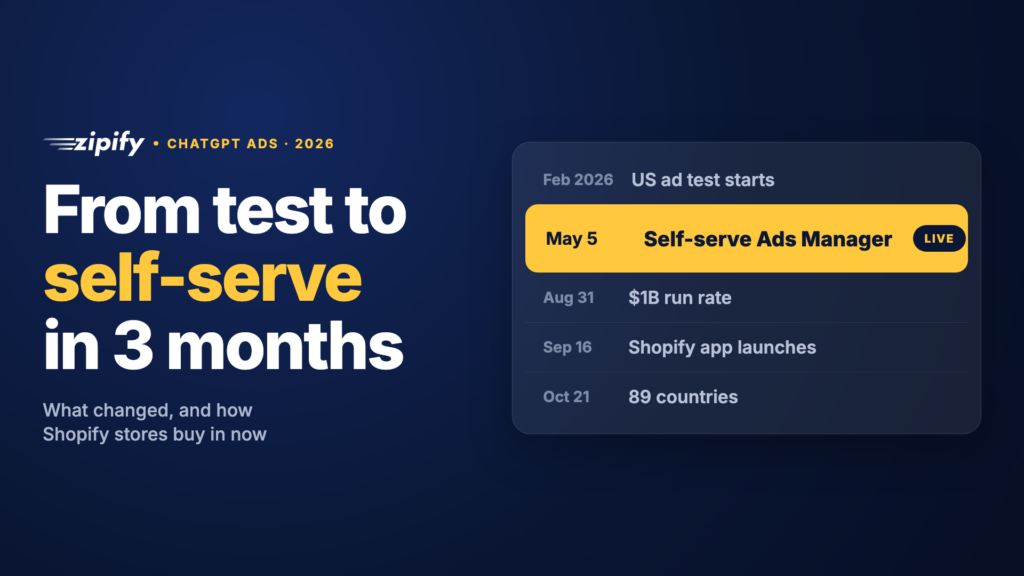
ChatGPT ads for Shopify stopped being a prediction in 2026. OpenAI started testing ads in the US in February, opened a self-serve Ads Manager in May, shipped a Shopify app in September, and by October 21 sold ads in 89 countries. The question now is which of the three ways to buy them fits your store, and whether you need an agency.
I rebuilt this guide from OpenAI’s announcements, Shopify’s Help Center and the ChatGPT app listing, checked on November 18, 2026. Our April version predicted self-serve buying in Q4 2026. It came in May.
TL;DR
- ChatGPT ads are live: OpenAI sells them through a self-serve Ads Manager, and as of October 21, 2026 they run in 89 countries.
- Ads show only to logged-in adults on ChatGPT’s Free and Go plans, below the answer and labeled as sponsored.
- Shopify stores can buy them three ways: the ChatGPT app in Shopify, Shop Campaigns (US, pay per conversion) or Ads Manager directly, alone or with an agency.
- Your product data decides how good your product ads look, so fix titles, descriptions and attributes before you spend.
- Work out the most you can pay per click from your AOV, margin and conversion rate before you set a bid.
Are ChatGPT Ads Live For Shopify Stores Yet?
Yes. ChatGPT ads have been live in the US since February 2026, and self-serve buying opened to all US advertisers on May 5, 2026. Shopify merchants got a direct route in September 2026 through OpenAI’s ChatGPT app in the Shopify App Store. By October 21, 2026, OpenAI said ads ran in 89 countries and more than 100,000 advertisers had used them.
Here’s how fast it moved, from OpenAI’s own posts:
Scroll sideways for more →
| Date | What happened | Source |
|---|---|---|
| Jan 16, 2026 | OpenAI announces an ad test for Free and Go users in the US | Testing ads in ChatGPT |
| Feb 2026 | Ads go live in the US as a test | OpenAI Help Center |
| May 5, 2026 | Self-serve Ads Manager opens in beta to US advertisers; CPC bidding added next to CPM; the earlier minimum spend is dropped | New ways to buy ChatGPT ads |
| Aug 31, 2026 | Ads pass a $1 billion annualized revenue run rate in under 200 days; available in 40+ countries | A milestone in expanding access to AI |
| Sep 16, 2026 | Shopify app for US merchants; Sponsored Agents enter testing | Reimagining advertising with AI |
| Oct 5, 2026 | Visual ads tested during image generation; new measurement partners | Building advertising for the way people use AI |
| Oct 21, 2026 | 26 more countries, 89 in total; 100,000+ advertisers since launch | ChatGPT Ads expands to 26 new countries |
Dates from OpenAI’s announcements, checked November 18, 2026.
The audience is why brands care: OpenAI says more than a billion people use ChatGPT every week, and most of them are on the free tier, where ads run.
What Do ChatGPT Ads Look Like?
A ChatGPT ad is a labeled sponsored placement that appears below ChatGPT’s answer, never inside it. It usually shows a brand name, a short line of copy and one or more product or offer cards, and the user can tap through to your site or, in some formats, keep chatting with the brand. OpenAI says ads run on separate systems from the chat model and don’t change the answer.
These are the example layouts OpenAI published with the test announcement, which Ezra Firestone walked through in his 2026 Shopify training. Here, someone asks for Mexican dinner ideas and a grocery advertiser appears under the answer with a hot sauce card.

In the second, a lodging brand adds a “Chat with” button that opens a conversation with the advertiser inside ChatGPT.

That second format is where things are heading. On September 16, 2026, OpenAI started testing Sponsored Agents, where a click opens a labeled conversation with the advertiser’s own agent, and on October 5 a visual format shown during image generation. Both are US tests with a limited group of advertisers.
Ads show to logged-in adults on the Free and Go plans; Plus, Pro, Business and Enterprise users don’t see them.
How Is ChatGPT Advertising Different From Google And Meta Ads?
ChatGPT advertising is matched to the conversation, not to a keyword. On Google, you bid on a search term. In ChatGPT, you describe the situations where your product helps, and OpenAI’s system decides whether your ad fits the conversation in front of it. Bids still matter, but relevance decides whether you show up at all.
That’s why Ezra Firestone, Zipify’s founder, compares it to Meta rather than Google:
“ChatGPT is one of the largest advertising audiences ever assembled, and it’s gonna be amazing for brands.” — Ezra Firestone
His point still holds after launch: the platform works from inferred intent, so it rewards clear creative and a clear product story more than budget games. In his words, “If you know how to run Meta ads, you’re gonna have a real advantage with ChatGPT ads.”
Scroll sideways for more →
| Google Search ads | Meta ads | ChatGPT ads | |
|---|---|---|---|
| What triggers the ad | The search keyword | Inferred interests and behavior | The topic and intent of the conversation |
| What you give the platform | Keywords and bids | Audiences, creative, a pixel | Descriptions of when your product fits, creative, a catalog, a pixel |
| Where it appears | Above and below search results | In feeds, Stories and Reels | Below ChatGPT’s answer, labeled sponsored |
If your Meta account already runs on broad targeting and strong creative, you’re closer to ready than a pure search advertiser. More on that shift in how Meta’s Andromeda update changed ad targeting.
How Can A Shopify Store Run ChatGPT Ads?
A Shopify store can buy ChatGPT ads three ways: through OpenAI’s ChatGPT app in the Shopify App Store, through Shopify’s own Shop Campaigns, or directly in OpenAI’s Ads Manager, on its own or with an agency. They differ in who controls the bids, how you pay and where you can reach.
Scroll sideways for more →
| Route | How you pay | Who runs it | Good to know |
|---|---|---|---|
| ChatGPT app in Shopify (by OpenAI) | CPM or CPC from your ad budget | You, in the Shopify admin | Free; syncs your catalog, uses the Shopify pixel |
| Shop Campaigns | Per converted customer, at a cost you set | Shop, from its own ad accounts | US only; runs on every listed platform, not ChatGPT alone |
| OpenAI Ads Manager | CPM or CPC bids | You or your agency | Full control; you set up tracking |
Checked November 18, 2026 on the ChatGPT app’s App Store listing and Shopify’s Shop Campaigns help page.
Route 1: the ChatGPT app in Shopify
This is the route most Shopify stores should test first, because it reuses your catalog and your Shopify pixel. The ChatGPT app is free and built by OpenAI; Shopify now calls it the ChatGPT Business app, since it also handles your business profile.
- Install the app from Sales channels > Agentic in your Shopify admin, or from the App Store.
- Connect an existing ChatGPT ad account or create one inside the app.
- Let it sync your product catalog, then build campaigns from those products.
- Track spend, clicks and conversions without leaving Shopify.
One warning from the listing itself: November 2026 reviews from UK and French merchants describe failed business verification and US-only catalog syncs. Outside the US, expect friction.
Route 2: Shop Campaigns
Shop Campaigns is the hands-off option: you set the customer acquisition cost you’ll pay, and you’re charged only when a customer converts. According to Shopify’s Shop Campaigns help page, ChatGPT is one of the third-party platforms where these ads can run, in the United States only. The catch: opting in runs your ads on all those platforms, so you can’t buy ChatGPT on its own this way.
Route 3: Ads Manager, yourself or with an agency
OpenAI’s Ads Manager gives you full control over campaigns, creative and bids. It fits when you want to test specific angles or hand the account to an agency, and it’s the route where you set up tracking yourself.
How Much Do ChatGPT Ads Cost?
ChatGPT ads have no fixed price. In OpenAI’s self-serve Ads Manager you bid per thousand impressions (CPM) or per click (CPC), and the May 2026 update removed the minimum spend that applied during the early test. Through Shop Campaigns you pay a customer acquisition cost you set yourself. What you can afford depends on your numbers, not on a benchmark.
I’m not quoting a “typical” CPM or CPC: the figures going around come from agencies and early testers, not OpenAI.
A better starting point is your break-even click price:
Most you can pay per click = average order value × gross margin × conversion rate
Here’s a worked example with round numbers (an illustration, not a benchmark). A store with a $70 average order value, a 60% gross margin and a 3% conversion rate on ChatGPT traffic breaks even at $70 × 0.60 × 0.03 = $1.26 per click. Raise the average order value to $80 and the same store can pay $1.44 per click, 14% more, for the same traffic. That’s why order value matters as much as the bid: offers on the product page, in the cart and after checkout, like the ones OneClickUpsell (OCU) runs from $9.95/month, raise what every paid click is worth to you. For the post-checkout piece, here’s how post-purchase upsells work on Shopify.
Start small, collect real conversion data, then reset your bid ceiling with the formula.
How Do You Measure ChatGPT Ads On Shopify?
You measure ChatGPT ads with OpenAI’s pixel and Conversions API, which record purchases, sign-ups and other actions, or with the Shopify pixel when you run ads through the ChatGPT app. Add UTM tags to every ad link so the traffic shows up separately in Shopify and GA4, and judge results on new customers, not only on attributed sales.
On October 5, 2026, OpenAI named measurement partners including Triple Whale, Northbeam and AppsFlyer for attribution, and Haus, Measured and WorkMagic for geo-based incrementality tests. If you already use one, add ChatGPT as a channel.
Three checks I’d run in the first month:
- Tracking: place a test order from a ChatGPT ad click and confirm it shows up in Shopify, in your attribution tool and in GA4 with your UTM source.
- New vs returning: compare the share of first-time buyers from ChatGPT with your Meta and Google numbers. A channel that only resells to existing customers isn’t adding much.
- Organic overlap: compare ChatGPT referral orders before and during the test, so you don’t pay for sales you were getting free.
What Should You Fix Before Spending On ChatGPT Ads?
Fix your product data before you spend, because ChatGPT builds product ads and organic recommendations from the same catalog. Clear titles, complete attributes, factual descriptions and accurate prices make your ads look better and help you appear in unpaid answers too. Weak data costs you twice.
The brands most likely to show up aren’t the biggest ones. They’re the ones with the cleanest product data. Start with your top 10 sellers:
- Titles that name the product type and the attribute people ask for (“Leakproof bento lunch box for kids”, not just a brand name).
- Descriptions with checkable facts: materials, sizes, use cases and what the product doesn’t do.
- Variants and attributes named the way shoppers say them, plus product category and barcodes where you have them.
- Crawler access for the bots behind ChatGPT search. Our guide to GPTBot and the other OpenAI crawlers shows which ones to allow.
That’s the job ShopRank AI was built for. It audits your product pages, gives you an AI Readiness Score from 0 to 100, and ranks the fixes by impact. It’s free to install for up to 50 products, with paid plans from $9.99/month (checked November 18, 2026).

See how ChatGPT reads your products.
For how products reach AI answers without paying, see our Shopify GEO guide.
Do You Need A ChatGPT Ads Agency For Your Shopify Store?
Most Shopify stores don’t need a ChatGPT ads agency to start. The ChatGPT app and Shop Campaigns are built for merchants to run themselves, and a small test tells you more than a pitch deck. An agency earns its fee once you need creative testing at volume, cross-channel attribution and weekly bid management.
The results for “ChatGPT ads agency” are mostly agencies ranking themselves, so instead of another list, here’s what I’d ask before signing:
- Show me live ChatGPT campaigns. Ads Manager screenshots, not general “AI marketing” case studies. Self-serve opened in May 2026, so nobody has years of experience.
- Have you run Shopify catalog campaigns? Product ads built from a synced catalog are different from text ads for a service business.
- How will you measure incrementality? Listen for a holdout or geo test, not only platform-reported ROAS.
- Who owns the ad account? It should be yours, with the agency added as a user.
- What’s the fee vs the media budget? Check whether the fee is a percentage of spend.
- What happens to Meta and Google? A good agency plans ChatGPT as one channel in the mix, not a replacement.
ChatGPT ads are also only one of the newer channels worth testing this year: we’ve written about AppLovin converting cold traffic at a 1.8 ROAS, and Ezra’s free guide to his top 5 new ad channels for 2026 covers the channels he runs for his own brands, with templates.

Frequently Asked Questions
Can Shopify stores outside the US run ChatGPT ads?
Yes, in many countries. OpenAI said on October 21, 2026 that ChatGPT ads run in 89 countries, and its Ads Manager reaches them. Shop Campaigns places ChatGPT ads in the US only. The ChatGPT app in Shopify started with US merchants, and recent reviews from UK and French stores report verification problems, so test it before you plan around it.
Do ChatGPT ads change what ChatGPT recommends?
No, according to OpenAI. The company says ads run on separate systems from the chat model, advertisers can’t shape or rank ChatGPT’s answers, and every ad is labeled as a paid placement below the response. That means paying for ads won’t lift your organic recommendations. Your product data and reputation still decide those, so treat ads and organic visibility as separate jobs.
Do I need ads to show up in ChatGPT?
No. Shopify already shares eligible products with ChatGPT through Shopify Catalog at no cost, so your products can appear in unpaid shopping answers without any ad spend. Ads buy you a labeled placement on top of that. For most stores, the order is: fix product data first, check how ChatGPT describes your products, then test ChatGPT ads for Shopify with a small budget.
Who sees ChatGPT ads?
Logged-in adults on ChatGPT’s Free and Go plans. Users on Plus, Pro, Business and Enterprise plans don’t see ads, and OpenAI says it doesn’t show ads to users under 18 or next to sensitive topics such as health, mental health and politics. Users can also turn off ad personalization, so plan your creative to work on the conversation’s context alone.
What I’d Do This Month
ChatGPT ads for Shopify are a live, self-serve channel now, not a Q4 bet. If I ran a growth-stage Shopify store, I’d fix the product data for my top 10 sellers first, since it improves both ads and free recommendations. Then I’d install the ChatGPT app, run a small test with UTM tags, and set my bid ceiling from my own numbers. An agency comes later, once the test shows new customers at a cost that works. And because ChatGPT ads charge for the click whether the order is large or small, every dollar of order value you add through upsells makes the whole channel easier to profit from.