

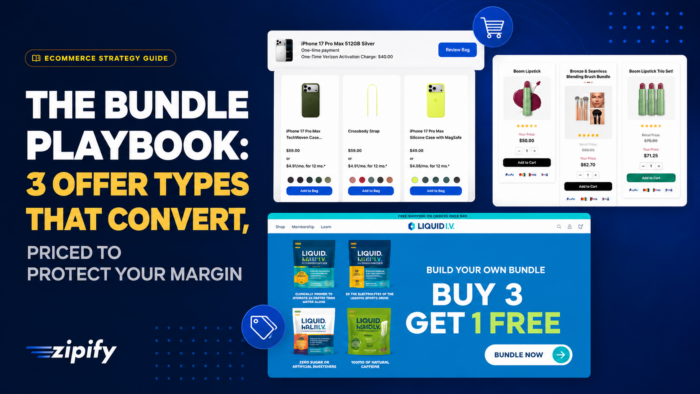
Why do most bundles fail? The products are usually fine. It’s the price that kills them.
In 2026, with increased CAC, a single-product purchase often doesn’t cover what it cost to acquire that customer.
One item, one transaction, thank you and have a nice day, that model worked when CAC was cheap. That model doesn’t work anymore.
Bundling is how you fix this problem. You’re not just asking your customer to spend more, you’re giving them more value, and increasing your margins. A win-win situation.
As discussed previously, a 10% lift in AOV can offset a 20% rise in CAC. Bundling is how you get there.
The 3 Bundle Types That Reliably Convert
1. Good / Better / Best (Tiered)

Use three price tiers and auto-select the highest tier. Most buyers avoid the extremes and choose the middle when they would have chosen the cheapest option before.
You anchor them to “Best” and they pick “Better.” Which is exactly where you want them. Design “Better” to clear a threshold, free shipping, a bonus item, and the pick is obvious.
2. Complete-the-Set (Complementary)

The friction of “what else do I need?” kills more AOV than most stores realize. The reason is that many shoppers are trying to solve a problem that can be solved with a single product.
Pair the hero product with what logically comes next, the case, the refill, the applicator, and that question disappears.
Apple almost never lets you buy a device alone. That’s not an accident.
3. Multi-Pack / Quantity Break

Offer the same product in a higher quantity for a small discount. Every consumable brand should be running this.
It moves AOV on day one and sets up reorder behavior at the same time.
Liquid I.V. leads with “Buy 3, Get 1 Free,” one offer, no complexity, and one of the fastest pre-checkout AOV lifts available.
Price It So the Math Actually Works
The price is where most bundle strategies fall apart. Stores spend time getting the product mix right, then guess on the price, or discount so deep the margin disappears.
Either way, the bundle works against you instead of for you.
The target: blended margin at 45% or above. Below that floor and you’re scaling volume at the expense of profit. (We break down blended margin math here)
Three Rules To Follow (From the E-commerce Bundle Cookbook)
- Build with 50–70% gross-margin products. That’s where your pricing flexibility actually comes from.
- Tier your discounts intentionally. 10% off two items. 15% off three or more. A flat discount across every config leaves money behind.
- Upsell high-margin add-ons after the bundle. The bundle is the floor. The add-on is the ceiling.
Discounting does the opposite of all of this: A 10% discount on a 50%-margin product needs roughly 25% more volume just to break even.
Capture AOV at Every Funnel Stage (Here’s the Map)

A bundle placed only on your product page is leaving money at every stage after it.
OCU lets you run bundle offers across the entire funnel, and we’ve seen AOV move at every touchpoint: product page, slide cart, in-checkout, post-purchase, and thank you page.
That’s why having a full-funnel upsell app like OneClickUpsell is so valuable in 2026. Because it lets you make offers across all stages of the buyers journey, so they see your offers when they’re most likely to say yes.
Get the System That Builds the Bundle for You
Bundles work because they don’t just increase order value, they increase the perceived value of what your customer is getting.
And these are just 3 of the 25 recipes in our Ecommerce Bundle Cookbook, organized by verticals like Beauty, Supplements, Apparel, Homegood, Pets, and more.

You can get the full AOV Bundle Cookbook for free when you register for Ezra’s AOV Workshop on July 30th.
Here’s what you get in the cookbook:
- 25 recipes by vertical
- A margin calculator
- 24-hour launch plan
So you can start growing your AOV this week.
[Register & Get the Cookbook →] Here
Sources
- Shopify, “Product Bundling: 5 Strategies & Examples for 2026”: shopify.com/blog/bundling-for-retail
- Shopify, “Average Order Value (AOV)”: shopify.com/blog/average-order-value
- McKinsey, “The Art of Cross-Selling”: mckinsey.com